
Two weeks ago I promised this post, so here it is, but a word of warning: it's a long story. I've tried to put pictures in to keep it interesting, but read at your own risk:
Part I: Finding our way
 I wasn't exactly sure where we were. Let me clarify: I knew where we were - we were west of Almaty on Zhandosova at the 20 km marker. The problem was that I wasn't exactly sure where to find the road that leads into the Aksai Valley. So while I knew where we were, I had no idea how to get where we were going.
"I'm gonna call Marsha and see if Mike can give us some land marks." I tell Dee and Jon as I pull out my cheap Nokia phone.
"Hi Marsha, it's Elizabeth...you don't happen to remember exactly where the turn off is for the monastery do you? Gas station and grey fence? Thanks...yeah, I'm sure we'll find it. Thanks."
"She says it's right before a grey fence." I looked around for a grey fence. Down the road further was a grey cement wall, but there was no accompanying gas station. Up the road, two strawberry salesmen stood in the shade of some trees with their flats of strawberries. "We could always try and ask" I suggested to Dee and indicated the strawberry salesmen.
Dee, Jon, and I walked toward the little strawberry stand.
"Hello" Dee said to the men as we approached the stand. "How are you?"
"Hello, thank you we are fine." Replied one of the vendors. "Where are you from?"
"From America," Dee answers.
"Would you like some strawberries?"
"Are they delicious?" Dee inquired. Asking whether produce is delicious is one of Dee's go-to Russian conversation pieces.
The man chuckled as he answered "very delicious."
"May I taste one?" Dee asked.
"Of course," he replied, and selected a large bright red berry from a pile on one of the flats.
"Oh, very delicious," Dee said as she bit into the strawberry.
"You don't happen to know where the street to Aksai is?" I asked the man, as Dee finished the strawberry.
"Aksai?"
"Yes, The Aksai Monastery. In the Mountains." I don't actually know the Russian word for monastery, but I use the word I saw on Google maps assuming it means monastery. It turns out that word means "cell" and that the Russian word for monastery (Monastir) sounds a lot like the English word for Monastery.
"Do you mean the church up there?" the strawberry salesman asks indicating the gorge where I knew we were headed.
"Yes," I reply with enthusiasm.
"Go back toward until you come to a small store on the right. The road you want is by the small store."
"May we buy some strawberries?" Dee asks the man.
"Sure, how many?" The man replies.
"Not a lot, half a kilo?"
The man laughs, says something to his partner in Kazakh as he throws several handfuls of the beautiful ripe strawberries into a plastic bag. "Money not needed" he says as he hands the bag to Dee.
"Really?!"
"Really, not a lot." The man laughs.
We thank the strawberry salesmen, and begin walking back up the road toward town until we come to an red-signed АСЗ gas station, corrugated tin fence, and a small store and know we've reached our road. So we turn up the road toward the mountains munching on fresh strawberries as the sweltering mid-morning sun climbs high into the sky.
Part II: the long road to the beginning of the trail
The trail to the Monastery begins around 8 kilometers south of Zhandosova. It is fairly easy to catch a taxi out to the 19km marker (we paid 1000tg for our taxi ride), or to take a bus (several buses including bus 11 go out that way) but getting a ride into the national park is a little trickier. As we walked along the road we took turns trying flag potential rides down. Finally a little grey sedan that looked a hundred years and a million miles old pulled over. We explained where we were going and the driver nodded toward the back seat.
we crawled into the back seat and I rested my feet atop the paint cans that filled the already limited floor space. With a squeal and a groan, the car slowly started forward.
As soon as the car began to move, I noticed strong odor of gasoline permeating the interior of the car. I tried to roll the window down, but when I pressed the button, all I got was a faint humming sound. We bumped and swerved our way up the rough road at an agonizingly slow pace. Each bump and rise brought a groan and squeal of protest from the car's over taxed suspension.
Finally we reached a hill the car just couldn't make it up. It groaned and protested, and then stopped. "Perhaps we should walk." I suggest to the drivers.
"Yes, it isn't far."
We crawled out, over the paint cans on the floor and back into the intense glare of the summer mid-day sun and begin to walk the narrow road lined by the tall cement walls of the homes and dachas.
The drivers were right, the entrance to the park was only a few hundred meters further along the road, but even that short distance felt unbearable in the heat. The sight of a ranger with a hose spraying the hot, dusty, road down was almost too much to handle, as we approached the gate, payed the entrance fee and went to look at the map.
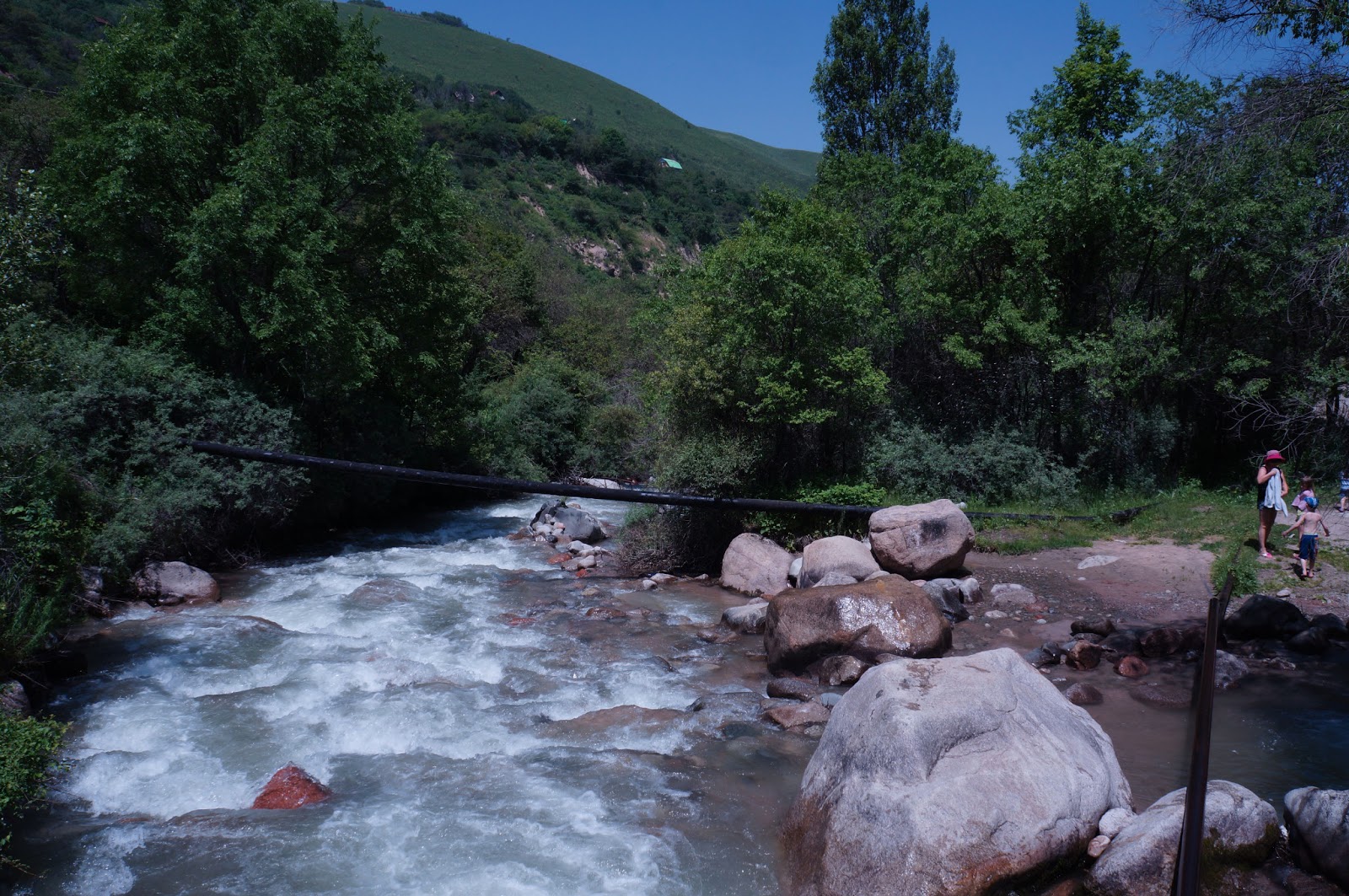
 It is several kilometers from the entrance of the park to the trail head to the monastery and trees that lined the road provided no shade from the day's unusually hot sun. As cars passed, we tried to get a ride, but most of the cars were filled with families out to enjoy a day along the river. The road follows a small river whose white waters bound and bounce through the rocky valley leaping over boulders and rushing under the 5 bridges that carry the road across it. Every now and again public picnic areas spring up along its banks, and in a few places, it is even slow enough for a dip.

The Hike and the Monastery
 The Trail to the monastery begins only half a kilometer up the road from where we lunched. What had been a well groomed, well traveled road in the fall, was now overgrown with brush. We climbed the steep hillside of the canyon, through the apple groves, just now beginning bud.
The trail to the monastery is quite steep and takes most people around two hours to hike. The first part of the trail cuts up and along one side of a steep gorge. In the fall the hillsides are covered in red and gold trees and the brush along the trail is laid low by the tread of a thousand feet. In the spring, however, the brush on the first part of the trail was often as tall as I was and many times completely obscured the trail.
 At the top of the gorge the trail finally crosses the spring-fed stream and enters the gate marking the monastery grounds. In the fall, the stream ran clear and clean and people drank without reservation from its waters. Today however, the stream water looked silty and unappetizing and as we began to climb the series of wooden ladders and steps up forested hill that the monastery tops, I began to worry about my rapidly depleting water supply.
  I shouldn't have worried, though. When we reached the top we were invited to drink from the monastery's water supply and the monk who was greeting visitors that day even filled our bottles with the cool water from the church. Any concerns I might have had about drinking unfiltered water from a natural source were dwarfed by much more pressing concerns about dehydration. We found out later from the off-duty police officer who drove us back into town (we were so happy that we didn't have to walk all the way out of the park). That the
temperature in town that day was over 36 degrees Celsius (close to 100
F). Strawberries, fun cars, long walks, hospitable monks, who could ask
for more on a hot day in Almaty?
I shouldn't have worried, though. When we reached the top we were invited to drink from the monastery's water supply and the monk who was greeting visitors that day even filled our bottles with the cool water from the church. Any concerns I might have had about drinking unfiltered water from a natural source were dwarfed by much more pressing concerns about dehydration. We found out later from the off-duty police officer who drove us back into town (we were so happy that we didn't have to walk all the way out of the park). That the
temperature in town that day was over 36 degrees Celsius (close to 100
F). Strawberries, fun cars, long walks, hospitable monks, who could ask
for more on a hot day in Almaty?


