Showing posts with label Central Asia. Show all posts

Sunday, December 29, 2013

Happy Holidays!

In honor of the celebrations of Christmas and the New Year, here is a short clip from Almaty's Christmas tree lighting party a few weeks ago.

Merry Christmas everyone and a very happy New Year!


Sunday, November 3, 2013

A Wild Week in Tajikistan's Fann Mountains

Iskanderkul Lake, Tajikistan
Shall I say right off to prepare for a rather long story about the amazing (and wild) world that is Tajikistan?

Saturday afternoon a friend and I flew to Dushanbe where we were met at the airport by our guide, Miskala, the owner of Orom Travel who had responded to our last minute request for a guide and driver with amazing speed and willingness to accommodate.  After a filling Indian meal at Namaste-Salaam, we began the drive from Dushanbe to Iskander Kul under grey skies.  By the time we reached the third and final toll booth before the ascent to Anzob pass, it was dark, and clouds were spitting rain.  The toll booth attendant told Miskala that it was snowing on the pass and that there was a big traffic jam up there.  After a brief conference we decided to press on.  When we reached the point where the rain turned to snow, we saw what the toll booth attendant meant.  Nearly a dozen big Chinese trucks were stopped haphazardly along a one kilometer stretch of road the drivers outside trying to attach their traction devices on the icy road.  Sprinkled among them was the odd Mercedes sedan, one with a trunk piled full with rocks in an effort to gain more control.  We weaved in and out vehicles stranded on the ice dodging an occasional Toyota coming down the hill, and with only one scary moment, we inched our way to the top of the hill and the "Tunnel of Death."
Aznob Tunnel ("the Tunnel of Death") Tajikistan

Anzob Tunnel is five terrifying kilometers of darkness and smog.  Apparently unfinished, the interior of the tunnel is some of the roughest road I've ever ridden on.  Once paved but now largely dirt, the way is mined with potholes and left-over construction equipment.  Steel reinforcement bars poke out of the tunnel walls.  Cars zigzag through the through the maze of ruts and potholes their low-beams illuminating the dust and smog that help give the ventilation-less tunnel it's nickname.  After 20 long minutes in the tunnel we emerged on the other side alive, but facing a steep icy descent from the pass. Miskala, for a moment, considered turning around but when we pointed out that either way she'd have to descend an icy road, we pressed forward.  Our Toyota Rav4 inched down the mountain passing cars that had slid into the drainage ditch or nearly off the road. As we dropped in altitude, the snow stopped, and then suddenly, the road was dry.

After another hour on a good road and an hour after that on a rough dirt road, we managed to reach Iskander Kul shortly after 11 pm, four and a half hours after leaving Dushanbe.  We stayed at the camp, a collection of thirty-odd cottages on by the shore of the lake, in a small, freezing cold wood-sided cabin with only one space heater for four rooms.  The night was cold, but the morning was colder - a frigid -6 degrees centigrade.  We breakfasted on a feast of fruit salad, fresh bread, and fried eggs in the glass-sided dining hall before walking around the turquoise lake set among jagged, rocky peaks to the Presidential Dacha and the legendary honeymoon
cave of Alexander the Great before walking through the gorge and then climbing up to an Autumn-gold sub-alpine meadow shaded by rocky mountains thrusting into the deep blue sky.  We followed the meadow to the village of Saratag, and then wound our way through the village, politely declining offers of tea from the villagers, until we were able to see the Great Ganza (over 5,200m in elevation).  After a quick trip to a suspension foot bridge we dined on potato soup and hot tea provided by a generous villager before beginning our walk back to Iskanderkul.

The next day, before leaving Iskanderkul, we took a short, half hour hike to a waterfall, and on our way back scrambled into an old, rusty hand-crank cable car and crossed the river.  After lunch we began the trip eastward to the Seven Lakes.


The road to Panjakent
If there is one thing I've learned about traveling in Tajikistan, it is to always add two hours to the estimated travel time.  After traveling north for nearly an hour the road splits at the town of Ayni.  One road (the nicer road) heads north to Khujand, the other, more of a dirt track made worse by ongoing construction, heads westward through the mountains to the border town of Panjakent.  The
road follows the Zaravshan River through a narrow gorge dotted with tiny villages colored red by the changing leaves of the apricot groves and crisscrossing the river on old one-lane cable suspension bridges. After nearly five hours (of a three hour trip) bouncing along occasionally paved dirt road and detouring through a village (where a young boy exclaimed in surprise "A Woman driver!") to get past a section of the road that is closed for construction. We arrived at our guest house just above the fourth lake just in time for dinner.

The road to Panjakent

Our Homestay
Jimuboi's guest house is of traditional four-bedroom mud construction with hand embroidered wall hangings, wood burning Pichka stoves for heat, and outhouse style facilities.  After the frigid cabin at Iskander Kul, the smokey warmth of the pitchka's was welcome.  The next morning, we drove along past the 5th and 6th lakes and then hiked up the too-rough-to-drive road to the 7th, final lake of the 7 lakes where we pickniked on the pebble beach, walked along the donkey path, used mostly to haul hey down from the alpine meadows, and listened to our guide tell stories of the eight day treks he's guided through these mountains.
Seven Lakes, Tajikistan (the Seventh Lake)

On our way back to the car we stopped in the village under the pretense of finding the school.  The children of the village were more than happy to talk to us and to guide us to the newly constructed school.  The school master let us look around inside and I even showed a couple of the kids how to play the old, dented bugle we found on one of the shelves. As we walked down the hill from the school, we stopped to talk with an old woman carrying an enormous piece of bread.  She explained how the bread was baked under a rock and even gave us a huge piece to try.  After saying farewell to the village children we drove back to our homestay to clean up before dinner.

The next morning dawned grey and dreary.  We drove leisurely back down the valley stopping to take pictures of the first four lakes and at a village to explore it's narrow streets and multi-home compounds before continuing our drive to Panjakent. 

Panjakent Bazaar
We arrived in the border town of Pajakent shortly after noon.  While Miskala arranged lunch, our Panjakent guide showed us around the round food bazaar.  We feasted on green salads and Plov (being vegetarian, I had a version of mac n' cheese made with Lagman noodles) in a cafe next to the bazaar before heading out to the museum.  Panjakent's museum tells the both history of the town and the history of the archeological discoveries of ancient Sarazm and ancient Panjakent.  After seeing the museum, we drove to the ruins of Sarazm and then to see the wall erected at the now closed Panjakent-Samarkand (Uzbekistan) border.  Our guide jokes that it is the "Berlin Wall" separating families from both cities and substantially impacting tourism as people wishing to visit historic sights from both cities can no longer cross the boarder here.  We spent the night in a soviet era Intourist hotel, exploring the nearby tea-house before dinner. 

Panjakent Tea House
Ayni Minaret
The following day was spent entirely on the return journey to Dushanbe. Back along the dirt road, through the deep gorge and over the old bridges and tiny villages.  A quick stop in Ayni to admire a 9th century minaret and to pick up some fresh bread to munch on in the car, and southward.  Back through the tunnel of Death, where it was still snowing but on dry roads this time, back down the valley to Dushanbe.

You've made it to the end of the post!  Congratulations!  Next post will probably be a monster picture post with pics of all the hikes I've taken this fall - unless something more exciting happens first...


Dushanbe, Tajikistan

Saturday, October 26, 2013

The story of the Best Birthday Ever


...in which I complete my first handshake money exchange, drink beer with a politician who could double for Psy, and see stars invisible to the naked eye...


It isn't every year, that your birthday falls on a Saturday, so when it does it's important to seize the moment and do something amazing.  For weeks leading up to the big weekend I had been hatching various forms of a plan all centering around an overnight at the Tien Shan Astronomical Observatory high up in the mountains above Big Almaty Lake.

As my birthday morning dawned, though, I still didn't have anything settled.  Calls to the observatory number listed in the Lonely Planet Guidebook had been unfruitful, and as two friends and I began the drive to the Big Almaty Lake with no reservations at the observatory and no clue as to the protocol for spending the night, and no native speaker of Russian in our midst, I was prepared to have to find a place to camp.

The road up the Big Almaty River gorge narrows to something just over one lane wide as it winds up the steep, pine covered gorge walls.  From time to time, it widens to allow for cars to pull off and admire the impressive views.  As we approached the top of the gorge, we found the way blocked by a red gate with peeling paint and a police car. As we pulled up to the location, the police officer showed no sign of moving toward us and I noticed that a half dozen other cars were parked in the narrow strip of gravel beside the road outside the gate.  I got out of the car and approached the police officer.

"I'm sorry, I don't speak Russian very well," I began.  I often begin negotiations in Russian with that expression because it usually improves my chances of understanding what is said to me as people choose simpler language than they might otherwise use.
"We are going to the Astronomical Observatory, can we enter?"
The police officer responded with some kind of explanation that completely escaped my entire Russian vocabulary but amounted to "no."
"Is it possible to drive to the observatory?" I asked
"Yes it is possible" the officer responded. 
"Is the road good?" I asked, thinking perhaps our car wouldn't make it.
"Yes, it is very good" the officer responded.
"So can we enter?"
Once again the officer strung several sentences together that entirely escaped me.
"I'm sorry," I said somewhat sheepishly "I don't understand."
The officer looked at me for a second and then sighed in exasperation,
"Alright, 2000tg and you can go,"
"Just a sec," I said. I returned to the car to report and get money.
As I returned to the officer with the gratuity, another man was approaching him.  The officer and I shook hands as he opened the gate to let us through.


The road climbed to the top of the dam before turning to the west and climbing to the plateau that is home to the collection of buildings that make up the observatory, we parked and then began looking around the buildings for any signs of life.  Inside a long, pink stone building with an atrium peeling paint and lecture seats lining the walls we found Nelly working in the Kitchen.  Nelly is an old woman with short grey hair dressed in camouflage pants, combat boots a sweater and a black beanie.
"I'm sorry, I don't speak Russian very well," I began once more, "do you know where I can ask about sleeping here tonight?"
"We have space, but no food.  How many people?" she asked curtly.
"Three people," I reply.
"Three thousand five hundred for each person and one thousand for the tour."
"Three thousand five hundred..." I began to repeat when she interrupted.
"Three thousand five hundred for you, three thousand five hundred for her, three thousand five hundred for him, but there is nothing to eat" Nelly said with a large gesture at each of us as she explains.
"Very good."  I reply. "Who do we pay?"
"You can pay me. Do you want some tea? You can go hiking and when you return, Tea, and then you can pay me."
"very good" I replied.


Nelly lead us back though the entry and down a narrow hallway before turning through a doorway that lead to a suite of four rooms with a bathroom and washroom.
"So," she said opening one of the rooms, "you can sleep two in here and one in here, or two in here and one in here or two in here and one in here, or if you want, two in this room and one in that one."  She had opened the doors to each room as she spoke, showing us our options. When my friends and I quickly chose two rooms to suite our fancy, Nelly said "just lock the door and take the key and they will be yours.

After settling in at the observatory, my friends and I decided to hike up to Kosmostansia, an ionosphere laboratory that sits 3346 m above sea level at the top of a ridge that connects Big Almaty Peak with the Turist peak.  While there is a paved road, we opted to take the trail, which ended in us climbing up a very steep grassy slope.  The view from Kosmostansia was phenominal and as we sat atop the chilly ridge breathing the fresh air and looking at the paths that lead to the summits of the two peaks the world was still and peaceful.

On our way out of the Kosmostansia facility, we encountered a black SUV with four gentlemen who had just brought out a two liter bottle of beer.

"Where are you from?" one of the men asked in Russian as we passed.  We stopped,
"From America," we answered.
"AMERICA!!!!" The four men yelled in unison.
"Do you want some beer?" One of the men asked, I looked to my friends
"Sure," they answered, "thank you."
We made general introductions as one of the men poured.
"look, look," said one of the others as he pointed at one of his friends, "Gangnam style!"
Sure enough, with sunglasses on, the man was a dead ringer for Psy.  We all laughed.
"They all promised me there would be snow up here,"  The man said reprovingly,  they promised me that I would be able to hold snow today, but no snow.  Just cold."

"What kind of beer is this?" I asked Mario, the man who'd been pouring the beer.
"It's just one of our local beers?" he replied.
"Not Chemkentskaya? I've heard that is the best." I said and an approving roar went up from the group.
"These two are from Shymkent," Mario explained as he took a smoked fish, broke it in half and began handing everyone a small piece. "For us Shymkent is like Texas..." Everyone laughed.
"Cheers."

We stood on the darkening road drinking beer, eating smoked fish and talking for about 20 minutes when Psy explained that he had to get to the airport and asked if we wanted a ride down the mountain. The next thing I knew, Lina was on my lap in the front seat, and Jack was squeezed into the back with Psy and two members of his entourage as Mario drove us down the narrow, winding mountain road to the observatory.


As we entered the observatory I found Nelly and asked if we could use the kitchen to kook some food.
"Yes of course" she answered.  "Tea?" she asked.
"Yes please" we all chimed.  Tea sounded really great after our climb.

We talked and sipped tea as our dinner of lentil and vegetable soup simmered in Nelly's Kitchen. Just as we finished Nelly told us we should go look at the stars now. She hurried us out the door but not before sending us back to our rooms several times to get warmer layers for the night air.  By the time we reached the little aluminum domed structure that houses the telescope the tourists get to use, a tour was already in progress.
"Come back in two hours," the telescope operator told us.
"Two hours!" we said with a fair amount of disbelief.
"Maybe one hour" he replied.
"OK" we said and the took a walk around the dirt roads that connect the many wooden and cement buildings of the facility admiring the night sky, isolated from the light pollution of Almaty by the towering peaks on all sides.  After about forty minutes we returned to the telescope and found it ready for the next group.  again and again, the guide casually positioned the telescope to point a an empty bit of blackness in the star-streaked night sky and then invited us one by one to look through the eye piece at a star cluster containing more than 300,000 stars, a double star, a dying star, and other wonders of the universe that are invisible to us for the vast majority of our lives.

That night I dreamed of stars and as we woke, breakfasted, packed, and took a farewell walk around the lake, I basked in the afterglow of the best birthday I could have ever wished for.

I'm off to Tajikistan, I'll have more stories and pictures from my fall hikes soon.

Sunday, July 7, 2013

Sunday Story: A small springtime adventure in the Aksai valley


Two weeks ago I promised this post, so here it is, but a word of warning: it's a long story.  I've tried to put pictures in to keep it interesting, but read at your own risk:

Part I: Finding our way

I wasn't exactly sure where we were.  Let me clarify: I knew where we were - we were west of Almaty on Zhandosova at the 20 km marker.  The problem was that I wasn't exactly sure where to find the road that leads into the Aksai Valley.  So while I knew where we were, I had no idea how to get where we were going.

"I'm gonna call Marsha and see if Mike can give us some land marks."  I tell Dee and Jon as I pull out my cheap Nokia phone.

"Hi Marsha, it's Elizabeth...you don't happen to remember exactly where the turn off is for the monastery do you?  Gas station and grey fence?  Thanks...yeah, I'm sure we'll find it.  Thanks."

"She says it's right before a grey fence."  I looked around for a grey fence.  Down the road further was a grey cement wall, but there was no accompanying gas station.  Up the road, two strawberry salesmen stood in the shade of some trees with their flats of strawberries.  "We could always try and ask" I suggested to Dee and indicated the strawberry salesmen.

Dee, Jon, and I walked toward the little strawberry stand.

"Hello" Dee said to the men as we approached the stand.  "How are you?"
"Hello, thank you we are fine." Replied one of the vendors.  "Where are you from?"
"From America," Dee answers.
"Would you like some strawberries?"
"Are they delicious?" Dee inquired.  Asking whether produce is delicious is one of Dee's go-to Russian conversation pieces.
The man chuckled as he answered "very delicious."
"May I taste one?" Dee asked.
"Of course," he replied, and selected a large bright red berry from a pile on one of the flats.
"Oh, very delicious," Dee said as she bit into the strawberry.
"You don't happen to know where the street to Aksai is?" I asked the man, as Dee finished the strawberry.
"Aksai?"
"Yes, The Aksai Monastery. In the Mountains."  I don't actually know the Russian word for monastery, but I use the word I saw on Google maps assuming it means monastery. It turns out that word means "cell" and that the Russian word for monastery (Monastir) sounds a lot like the English word for Monastery.
"Do you mean the church up there?" the strawberry salesman asks indicating the gorge where I knew we were headed.
"Yes," I reply with enthusiasm.
"Go back toward until you come to a small store on the right. The road you want is by the small store."
"May we buy some strawberries?"  Dee asks the man.
"Sure, how many?"  The man replies.
"Not a lot, half a kilo?"
The man laughs, says something to his partner in Kazakh as he throws several handfuls of the beautiful ripe strawberries into a plastic bag. "Money not needed" he says as he hands the bag to Dee.
"Really?!"
"Really, not a lot." The man laughs.
We thank the strawberry salesmen, and begin walking back up the road toward town until we come to an red-signed АСЗ gas station, corrugated tin fence, and a small store and know we've reached our road.  So we turn up the road toward the mountains munching on fresh strawberries as the sweltering mid-morning sun climbs high into the sky.


Part II: the long road to the beginning of the trail

The trail to the Monastery begins around 8 kilometers south of Zhandosova.  It is fairly easy to catch a taxi out to the 19km marker (we paid 1000tg for our taxi ride), or to take a bus (several buses including bus 11 go out that way) but getting a ride into the national park is a little trickier.  As we walked along the road we took turns trying flag potential rides down.  Finally a little grey sedan that looked a hundred years and a million miles old pulled over.  We explained where we were going and the driver nodded toward the back seat.

we crawled into the back seat and I rested my feet atop the paint cans that filled the already limited floor space.  With a squeal and a groan, the car slowly started forward.

As soon as the car began to move, I noticed strong odor of gasoline permeating the interior of the car.  I tried to roll the window down, but when I pressed the button, all I got was a faint humming sound.  We bumped and swerved our way up the rough road at an agonizingly slow pace.  Each bump and rise brought a groan and squeal of protest from the car's over taxed suspension.

Finally we reached a hill the car just couldn't make it up.  It groaned and protested, and then stopped.  "Perhaps we should walk." I suggest to the drivers.
"Yes, it isn't far."

We crawled out, over the paint cans on the floor and back into the intense glare of the summer mid-day sun and begin to walk the narrow road lined by the tall cement walls of the homes and dachas.

The drivers were right, the entrance to the park was only a few hundred meters further along the road, but even that short distance felt unbearable in the heat.  The sight of a ranger with a hose spraying the hot, dusty, road down was almost too much to handle, as we approached the gate, payed the entrance fee and went to look at the map.  

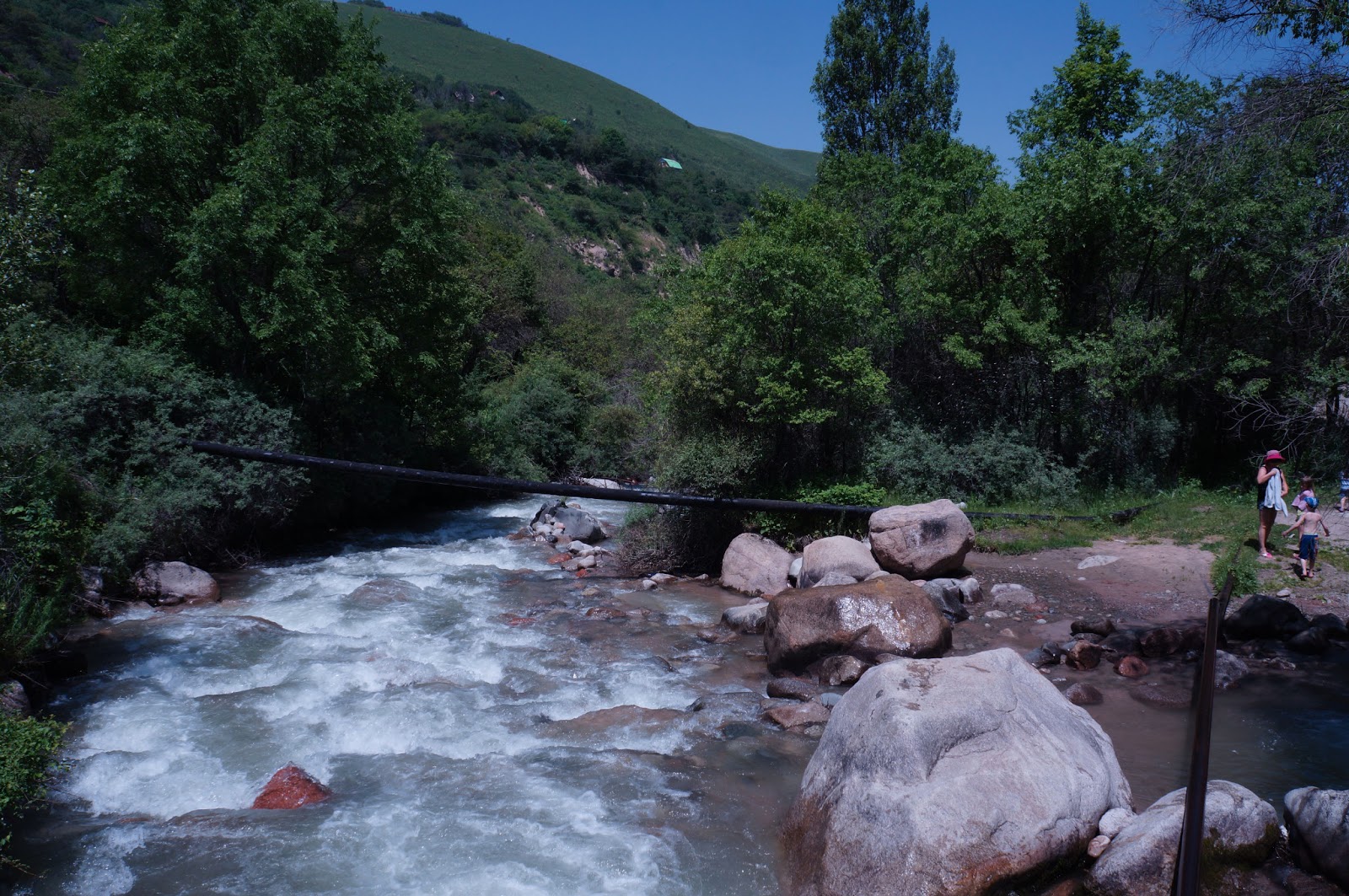
It is several kilometers from the entrance of the park to the trail head to the monastery and trees that lined the road provided no shade from the day's unusually hot sun.  As cars passed, we tried to get a ride, but most of the cars were filled with families out to enjoy a day along the river.  The road follows a small river whose white waters bound and bounce through the rocky valley leaping over boulders and rushing under the 5 bridges that carry the road across it.  Every now and again public picnic areas spring up along its banks, and in a few places, it is even slow enough for a dip.

Each time we crossed the river we took a bath in its refreshingly cool waters and then re-applied sun screen.  Water and sunscreen were our only defenses from the day's brutal sun.  two and a half hours and three river baths later, we came to the gravelly remnants of an old mud slide, a place where the river slowed a bit and where little copses of birch trees along the water's edge provided some shade.  We sat down to rest our feet, munch on a lunch of cheese and Jam Sandwiches and M&M's, and watch people as they stopped at the spot to wade and splash in the slower waters of this part of the river.

The Hike and the Monastery

The Trail to the monastery begins only half a kilometer up the road from where we lunched.  What had been a well groomed, well traveled road in the fall, was now overgrown with brush.  We climbed the steep hillside of the canyon, through the apple groves, just now beginning bud.

The trail to the monastery is quite steep and takes most people around two hours to hike.  The first part of the trail cuts up and along one side of a steep gorge. In the fall the hillsides are covered in red and gold trees and the brush along the trail is laid low by the tread of a thousand feet.  In the spring, however, the brush on the first part of the trail was often as tall as I was and many times completely obscured the trail.


At the top of the gorge the trail finally crosses the spring-fed stream and enters the gate marking the monastery grounds.  In the fall, the stream ran clear and clean and people drank without reservation from its waters.  Today however, the stream water looked silty and unappetizing and as we began to climb the series of wooden ladders and steps up forested hill that the monastery tops, I began to worry about my rapidly depleting water supply.  

I shouldn't have worried, though. When we reached the top we were invited to drink from the monastery's water supply and the monk who was greeting visitors that day even filled our bottles with the cool water from the church.  Any concerns I might have had about drinking unfiltered water from a natural source were dwarfed by much more pressing concerns about dehydration. We found out later from the off-duty police officer who drove us back into town (we were so happy that we didn't have to walk all the way out of the park).  That the temperature in town that day was over 36 degrees Celsius (close to 100 F).  Strawberries, fun cars, long walks, hospitable monks, who could ask for more on a hot day in Almaty?


Monday, June 24, 2013

One last Hurrah: The Kolsai Lakes


 I am leaving Kazakhstan tonight for six weeks in Colorado, England and Scotland (don't worry, I plan to be back in Kazakhstan in August).  So this weekend, was my last chance for a romp in the country-side of southeastern Kazakhstan.  Some friends and I used the opportunity to go camping and hiking at the famed Kolsai lakes in the mountains on the Chilik River.


To reach the Kolsai lakes, you drive east from Almaty turning south just before crossing Charyn Canyon. The landscape shifts from the red rocks of the Charyn Canyon, to rounded green hills somehow reminiscent of hobbiton.  As the road leads into the mountains, it deteriorates drastically, and the last 30 kilometers involve the arduous dodging of dangerous potholes.


By the time we reached the first lake on Friday evening, it was well after dark.  We paid the park fees, camp fees (750 tg per tent)  went about setting up camp in the dark.  Our evening ended with a delicious burrito dinner, and a roaring fire with s'mores beneath the nearly full supermoon.

Saturday morning brought a gorgeous view of the first lake, and droves of tourists prompting us to pack up camp and head up the trail to the second lake.


There are three Kolsai lakes, the first you can reach by car, but the second and third require a hike or a ride on horseback.  The second lake is about eight kilometers from the first and takes around four hours to reach by foot. The trail is well marked and not too difficult but it does get pretty steep in places, most notably the first and last parts.

The first section of the trail climbs the steep hillside above the first lake and cuts across grassy, wildflower dotted hillsides, high above the first lake.  The trail then drops back down to the river and winds through the forested valley following the river.  The constant roar of the water rushing through the boulder strewn river bed accompanies all but a few short sections of the trail.

The last two kilometers leading to the second lake are one long, steep uphill climb and we climbed it with the sound of summer thunder ringing in our ears.  We reached the top and found a sheltered spot only minutes before the first of the afternoon downpours began.


The Second Lake:


the mountains above the second lake

our camp is in this picture somewhere
The third lake is an additional five steep kilometers from the second taking between two and three hours to hike.  We didn't have enough time to hike to the third lake.  Instead we camped at the second and enjoyed a nice morning sleeping-in and swimming in the frigid water.


I wish this picture did justice to the moon on Saturday night


One last picture of the first lake...


Next stop: Durango Colorado


Monday, June 17, 2013

Almaty from way up here: Hiking in the Tien Shan mountains

Since the last post was all about the story, this one is all about the pictures.  There is a bit of a story too, but it will mostly be pictures.  Did I mention there will be pictures?  If you are still waiting for it to load, it might be because of all the pictures.

OK, ok, enough of that.  Springtime in Almaty brings with it a return to the outdoors.  Each weekend, I find myself drawn into the mountains of the Tien Shan Range.  Last weekend I went back to the Monestary with some friends, but that's a longer story so I'll have to tell you more about it later.  Yesterday, I hiked from just below the medeo Gondola up to Kumbel peak.  The hike was long and took us well over six hours to reach the top and another three hours to come back down.  The view from the top, though, was worth every step.  So, seeing as I have nothing more to say that pictures couldn't say better,  I'll leave you with the pictures:

Our first view of the Shymbulak Gondola as we started up.

Our first view of Almaty (there were many, many more).


...and now we can see the peaks


Nearing the top of our first leg: that bright green in the distance.

Looking back down the trail

the "saddle" - top of stage one

technology is hard when the sun is shining.


Stage two: the climb to four rock formations called "The Three Brothers"

Pause for the view, and to catch a breath.


Atop one of the Three Brothers

Almaty from way up here


The Top:


Interestingly, A bit about the Kazakh Alpine Club was in my dashboard this morning and features the same mountain that you see behind me.  Check it out Bob McKerrow - Wayfarer: In the footsteps of Anatoli Boukreev, Maxut Zhumayev sets up the Kazakh Alpine Club